That Time of Year Again... Bugs are Back!

unsplash-image-t3_fw2w1CcI.jpg

Springtime is here in Oklahoma, and along with the nicer weather and longer days comes an onslaught of bugs.

Most are merely irritating, but ticks and mosquitos can carry disease.

Kids need to be outdoors so they can get some exercise, learn about nature and explore, but how do we protect them from the bugs?

First, use protective clothing – long sleeves, long pants and hats when bugs are likely.

Put insect repellent directly on the clothing and also on exposed skin. For young children, don’t use it on their hands. To apply to the face, spray into your hand and rub on the cheeks, chin and forehead, staying away from the eyes and mouth. DEET (in concentrations of 30 percent or less only in children over two months old), picaridin (also known as P-methane diol or PMD), IR-3535, and oil of lemon eucalyptus (only for children over 3 years of age) have been shown to be effective.

After being outside, shower or bathe your child as soon as possible.

Thoroughly check for ticks at that time and at least once a day during tick season. Not only does showering improve your chances of finding a tick (often even before it attaches), it also helps to wash off chiggers and the oil from poison ivy before they cause itching.

If you do find a tick attached, it should be removed as soon as it is found. The sooner it is removed, the less likely it is to cause disease.

Stay calm so your child will too. For a small or scared child, it helps to have another adult to make sure the child doesn’t move while you’re removing the tick.

It doesn’t hurt, but kids get scared. Grasp the tick with tweezers as close to the skin as possible and pull gently and steadily until the tick releases. A little piece of dead skin may come off with the tick – that’s GOOD! It means you completely removed the head and mouthparts.

Wash the area with soap and water. The bite may get red and itchy

Concerning Kids

over the next few days, but unless it gets bigger than a quarter or is rapidly worsening, that’s OK. It might take days to weeks to completely heal.

Most tick and mosquito bites don’t cause anything worse than itching, but when they do they need attention. The most common tick borne disease in Oklahoma is Rocky Mountain Spotted Fever, which usually occurs a week or two after a tick bite, with fever, rash and headache being the common symptoms.

It usually responds very well to appropriate antibiotics when treated early after symptoms appear. We hear a lot about Lyme Disease, but the Oklahoma State Department of Health reports that there has never been a proven case of human Lyme disease in either Oklahoma or any southern state. Another newly recognized tick-borne illness, called Southern Tick Associated Rash Illness (STARI) is similar to Lyme disease but does not seem to cause the long term ill effects of Lyme disease.

Mosquito bites can carry West Nile virus, which usually only causes a mild illness, but in rare cases it can cause severe disease which is hard to treat. It is most common in later summer.

Take the above measures to protect your children from mosquito and tick bites as much as possible, but don’t panic when your child is bitten: most bites won’t cause any problems. For more information go to healthychildren.org, the American Academy of Pediatrics website for parents.

Susan Bullard, M.D., retired pediatrician who practiced 29 years in Stillwater, member of the Early Childhood Coalition here in Payne County and an initiator of the Healthy Steps program at SMC Pediatrics


Keeping Up with the Kids

unsplash-image-kV_v8TJ9NW0.jpg

Spring is baby season in the natural world, and I can’t resist peeking in on the chicks at the local feed store or watching young goats chase each other around the field near my house. These babies all seem to have just one setting...ON.  Small humans are no different, which is why their parents are tired much of the time.  It’s no secret that youngsters don't follow the same time schedule and rules as adults!

As soon as they wake each day, babies are busy doing exactly what they want to do, which is to make their own sense of the world, especially the people, around them. Our job is to provide a safe and nurturing environment and to be their first teachers.

The fun part of being a teacher is singing, laughing, listening, reading, and playing with our kiddos as they build their knowledge. The harder part is that any time they are awake, they have no OFF switch.  Regardless of our adult needs and schedules, children keep right on learning, driven by the rapid growth of their bodies and brains.  Also, they are always learning so much more than we intend to teach.  They parrot our favorite words, good and bad.  They imitate our ways of turning a page, twirling our hair, and picking a fight. They are little scientists experimenting with cause and effect, and we are their main research subjects.  No wonder we are tired... it is hard to keep up our little busybodies!

Fortunately, children generally follow the same pattern for developing and learning. They sit first, then crawl, then walk, run, and finally leap across the stage or playing field.This goes for physical development and also for mastering feelings, interacting with other people, and developing a conscience. But every child follows their own internal clock that dictates when the time is right for moving from one stage to the next. Of the two children I know best, one walked at nine months and one at fourteen months, and they both get around just fine as adults. In fact, it isn’t until around eight years of age that stages of development even out among most children. During those early years, we need to worry less about when a child masters a particular skill, and pay more attention to giving them the time and encouragement they need to work on all the things that will make them successful, lifelong learners.And that brings us back to the fun part of teaching, because the way that people learn best is through play. As we sing, dance, pretend, read, and talk with our children, they are making the most of every minute to learn exactly what they need to know at that stage of their development. The time we spend playing with our children shows them that we respect their need to learn in their own way, and at their own time, even if we can’t always keep up!

Holly Hartman is Director of Publishing at Unite for Literacy and an Early Childhood Coalition member

Staying Right Where You Are

Be present. Stay in the moment. Have you heard phrases like this?

They are intended to help us keep our minds focused on where our bodies are; being present can help us out tremendously when worry or anxiety start to get the better of us by stopping negative thoughts and helping us settle down and focus on where we are in that moment.

When you’re eating, are you tasting the food, or are you mentally miles away thinking about something else?

When you drive into work, do you notice the beautiful sunrise, or are you having a hypothetical argument all by yourself?

I’m a big believer in being present, and I’ve seen it help adults and kids alike manage overwhelming thoughts and feelings. I recently discovered that I was failing at being “in the moment” in a big way.

The other night over dinner with my child, I took advantage of momentary silence to start in on a litany of questions: Who did you sit with at lunch today? Do you have any homework? Have you laid out your clothes for tomorrow?

Pretty quickly a casual dinner turned into the equivalent of a planning meeting. Neither of us was happy with how it was going.

I realized with a start that not only was I failing to be in the moment, but I was spoiling the opportunity for real interaction. I decided that I was going to try to change the tone of dinner, and I focused on those things that were immediately around us: things I could see, hear, smell, feel, and taste.

I commented on the orange leaves on the tree in our backyard, and in return my child perked up and noticed a squirrel working busily around the base of the tree.

We talked about the taste of the food we were eating, and what the ingredients were.

We laughed, and dinner extended a few minutes longer than usual.

My child looked happier, and I felt better than when I was on the verge of nagging. For a few minutes, we enjoyed being right where we were, together.

I don’t want my child to grow up with a running to do list in her head, or worse yet, with a nagging sense that she’s not doing enough.

I want her to know the full experience of hot soup on a cold and windy day, and not get lost in preoccupations with what comes next.

Did I check homework later that night? You bet I did. Did those clothes for the next day get picked out? Yes, and with a good bit of protest. It wasn’t the content that needed to be changed, but my timing. I had to decide on purpose that I was going to make dinner a time to be present, and teach my child how to do the same.

I’m still not used to taking breaks to “live in the moment,” but with practice, I’m getting better.

Dr. Ginger Welch is a Clinical Associate Professor at OSU, and a member of the Early Childhood Coalition.

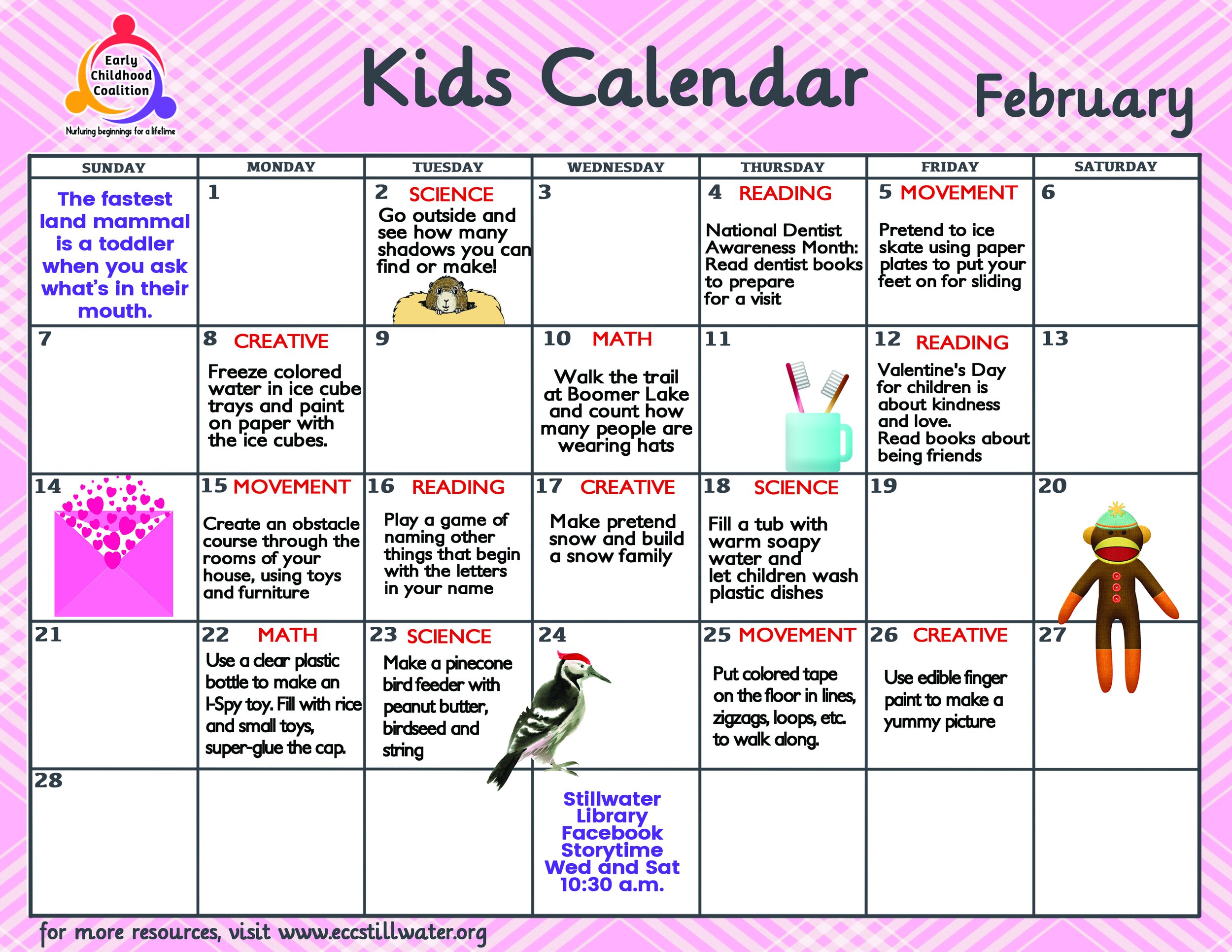
February Kids Calendar

This month we are introducing a new feature to our website and Facebook pages. Our Kids Calendar is meant to help caregivers find fun things to do for children in the Stillwater area. If you have an idea or event to add, please get in touch!

ECC February Kids Calendar 2.jpg

Dentist books: https://www.craftplaylearn.com/dentist-books-for-preschoolers/

Pretend Snow: https://buggyandbuddy.com/white-playdough/

Kindness Books: https://imaginationsoup.net/childrens-picture-books-kindness/

Edible finger paint: https://theimaginationtree.com/homemade-edible-finger-paint-recipe/

Thank You, Elite Repeat!

We are grateful to Elite Repeat for continuing their funding of the Early Childhood Coalition. Elite Repeat funding has paid for the children’s books that are distributed at Healthy Steps visits, staff attendance at national conferences, and support materials for our outreach activities. In spite of the tough economic climate caused by the pandemic, Elite Repeat has affirmed our importance to the community by supporting us again in 2021, and we are thankful!

Elite.png